
Searching Cook County Criminal Dockets
The public entry point for a Cook County criminal docket is Minnesota Court Records Online (MCRO) Case Search. Pick the Criminal category and the Cook County court location to narrow results. MCRO accepts a name, case number, citation number, or attorney. It also serves as the public Register of Actions. It is not a certified record. Attorneys, government agencies, and guardians ad litem file through Minnesota eFile and eServe. That system is usually called eFS. It handles filing and service, not public lookup.
For a criminal case in Cook County, the complete file or citation number works best. Name searching demands a last and first name at minimum. Try a middle initial if an exact match fails. The Sounds Like option can help too. Confirm venue, case type, and filing date before opening Case Details. The Cook County case lookup reference covers these same search choices across case categories.
- Accept the MCRO terms, choose Case Search, and select the Criminal category.
- Choose Cook County under specific county court locations, then enter a case number, citation number, name, or attorney information.
- Open the matching result and confirm the Cook County location before reading the Register of Actions.
- Review Case Events, Hearings, Charges, Dispositions, and financial entries in that order.
- Use the Cook County courthouse terminal or Cook County Court Administration if the remote result is absent, incomplete, or a certified copy is needed.
Note: MCRO results are unofficial. Confirm a current court date or get a certified document through the court record custodian.
Cook County Criminal Docket Name Limits
A blank name result does not prove a case is absent. Search MCRO by defendant name and it will skip pending criminal, traffic, and petty-misdemeanor matters lacking a conviction. The full court file number or citation number avoids that gap. An attorney or bar-number search may also work. The official MCRO FAQ explains exact-name searching, wildcard limits, and the pending-case restriction.
Cook County criminal docket check: Start with the exact number, verify the county selection, and then use the Cook County courthouse terminal if the remote search still does not answer the record question.
Want a fuller electronic view of public district-court records? Use the public terminal at the Cook County courthouse. Cook County Court Administration can also point you to locally stored public paper files. For a specific setting, the Cook County weekly public calendar and the local Court Administration line confirm details, though neither turns a remote omission into a cancellation. Requesting copies by mail or email? Call first for the current form, accepted delivery method, and payment instructions.
Inside a Cook County Criminal Docket
Think of the criminal Register of Actions as a dated log of what the court received and what it did. Identifying information comes first. After that come parties, charges, warrants, interim conditions, assignments, case events, hearings, dispositions, bond or bail activity, financial information, and public documents. Per the official MCRO Case Details guide, empty sections simply do not display. So an entry you can see never guarantees that every category applies to the case.
| Case number | Minnesota file number with county, type, year, and sequence components, such as XX-CR-YY-NNNN. |
|---|---|
| Case information | Cook County location, caption, filed date, judicial officer, status, flags, and related cases where entered. |
| Charges | Offense description, cited statute, level, count, and recorded charge status or amendment. |
| Case events | Dated filings, notices, orders, and proceedings in chronological Register of Actions order. |
| Hearings | Date, time, location, judicial officer, setting type, and hearing status when displayed. |
| Disposition | The recorded outcome and date. A criminal case type does not state the final result. |
| Bond and financials | Bond or bail activity, costs, fines, restitution, payments, and balances where entered. |
Read the event text itself. An Index# or DOC ID# only identifies a document in the system and says nothing about legal importance or order. Keep in mind, too, that a public docket entry can stay visible even when its underlying document is not available remotely.
Cook County Criminal Docket CR and VB
Two Minnesota case-type markers explain a lot of Cook County criminal docket results. CR usually signals a matter requiring a court appearance. VB usually signals a payable, non-mandatory citation case. These markers route a search. They predict nothing. A case type is not a conviction, dismissal, sentence, or any other outcome. The state's citation and case-number guide covers the CR and VB distinction and the standardized citation number.
- Charge
- An allegation listed with an offense, classification, and recorded status.
- Disposition
- The case or charge result recorded by the court, with the specific wording and date controlling.
- Interim conditions
- Conditions shown before final disposition when they are entered in Case Details.
- Warrant indicator
- A public system marker that should prompt a current-status question to Court Administration, not an independent conclusion.
Cook County publishes no local abbreviation list, so treat shorthand as unofficial. Rely on the full MCRO language instead. When a term affects a required appearance or record request, ask Cook County Court Administration.
How a Criminal Case Moves
The Cook County District Court Register of Actions records a criminal case through the local trial process. Every case differs, yet the history often opens with a complaint or citation. Summons or warrant activity may follow. Then comes a first appearance or arraignment, bail or bond, and pretrial or omnibus activity. Motions, a plea or trial, a disposition, and sentencing may come after that. Payment activity and an appeal-related filing can round out the record. The newest hearing entries matter most. An earlier setting still sitting in the history means less than the current one.
Cook County criminal docket flow: Filing → Arraignment → Pretrial → Plea or Trial → Disposition → Sentencing
A continuance pushes a setting to a later date. A reset creates a new setting after a prior date changes. The Cook County Register typically keeps the old event. It also adds a newer one. Words like "Held," "canceled," or "continued" only make sense alongside their date and neighboring events. And note that a disposition can appear before all Cook County financial or post-judgment activity wraps up.
Cook County Criminal Docket Date Checks
Three Cook County sources work together for checking a criminal hearing date. The Cook County Register of Actions is one. So are the Cook County public calendar and Cook County Court Administration. Use MCRO Hearing Search to pull public settings by case, party, attorney, or judicial officer. The Cook County weekly public calendar goes up at 7:00 a.m. on business days. It gets refreshed hourly, though it leaves out some matters. For the freshest daily calendar, check the printed copies. They sit outside Cook County courtrooms or in the public lobbies.
| Check | What it helps confirm | Limit |
|---|---|---|
| Cook County MCRO Register | Recorded Cook County hearings and later case events | Remote access is limited for some Cook County records. |
| Cook County weekly calendar | Cook County public session view for a listed date | It omits confidential and non-remotely accessible matters. |
| Cook County Court Administration | Cook County date, time, location, and whether a setting moved | Local confirmation is needed when sources conflict. |
A phone call works when a Cook County criminal setting matters. Dial Cook County Court Administration at (218) 264-7001 and pick option 2. Have the Cook County file number, caption, citation number, and the rough hearing date ready to state. During published business hours, the courthouse counter and its terminal are solid alternatives too.
Courts That Hold Criminal Dockets
Minnesota runs one unified District Court. So Cook County has no separate county, justice, or municipal criminal courts. Every criminal level sits in the same place. Cook County District Court operates from the Cook County Courthouse at 411 W. Second Street, Grand Marais, Minnesota 55604. Cook County Court Administration holds the local criminal docket and records. The published contact is (218) 264-7001, option 2. Felony, gross misdemeanor, misdemeanor, petty misdemeanor, and related payable criminal or traffic matters are all handled at this single court location.
| Cook County criminal matter | Trial venue | Public access path |
|---|---|---|
| Felony | Cook County District Court | MCRO, Cook County courthouse terminal, or Cook County Court Administration. |
| Gross misdemeanor or misdemeanor | Cook County District Court | MCRO, Cook County calendar, Cook County courthouse terminal, or Cook County Court Administration. |
| Petty or payable matter | Cook County District Court | Cook County MCRO by case or citation number, with local confirmation if needed. |
No Grand Marais municipal criminal docket exists. Cook County criminal filings live in District Court. An odd Cook County ordinance or administrative question should go to Cook County Court Administration, not to some guessed-at local portal.
Cook County Criminal Docket Recovery Court
The Shore Substance Use Recovery Court serves Cook County as a Sixth Judicial District treatment-court program. It is not its own court level. Nor does it run a separate public docket portal. Start instead with the underlying Cook County District Court criminal case and the Cook County Register of Actions. The Sixth Judicial District lists the program. One coordinator is shared by the Cook County and Lake County programs; case-specific questions belong at the Cook County courthouse. Program assignment, conditions, and related Cook County events can show up in the underlying record. But public access rules still limit what any remote search displays. Treatment plans, assessments, health information, and participant details may be confidential or restricted to the Cook County courthouse. And if a program name never appears in MCRO, that alone does not rule out a Cook County recovery-court connection.
Sealed Dockets and Public Access
Access to Cook County criminal dockets follows the Minnesota Rules of Public Access and the Minnesota Government Data Practices Act. Court rules govern Cook County judicial records. What you can see remotely through MCRO is narrower than what you can inspect at the Cook County courthouse. Special limits apply to protected identifiers, trial and hearing exhibits, and certain categories like domestic-abuse, harassment, and juvenile matters. A sealed or confidential Cook County entry may be restricted, absent from remote results, or open only under a court access order.
Cook County criminal record rules:
Rule 4 identifies court-record categories that are not routinely public or have special public-access limits.
Rule 8 distinguishes public inspection from narrower remote electronic access and limits remote identifiers and exhibits.
Rule 7 provides the path for seeking access to a record that is not routinely available.
Minn. Stat. ch. 609A governs the criminal-expungement process; an expunged case is not an ordinary public remote-search result.
A contested Cook County confidential-access question may require the CON100 and its related court-order process. Cook County Court Administration can point you to the local filing path. But a judge decides contested access. A routine copy request is no substitute for that process. Note: An empty remote result can reflect search limits, privacy restrictions, expungement, retention, or an older paper file rather than the absence of a case.
Cook County Criminal Docket Federal Split
A Cook County criminal docket search reaches Cook County District Court records, nothing federal. Federal criminal cases in the region belong to the United States District Court for the District of Minnesota. Those are kept in separate CM/ECF and PACER systems. The Cook County court Register may note an appeal-related event in a state case. But that note never becomes the federal docket. The District of Minnesota CM/ECF court information describes the federal electronic filing and docket system, including the Duluth division. Its federal case format and court flags belong entirely to that independent federal system.
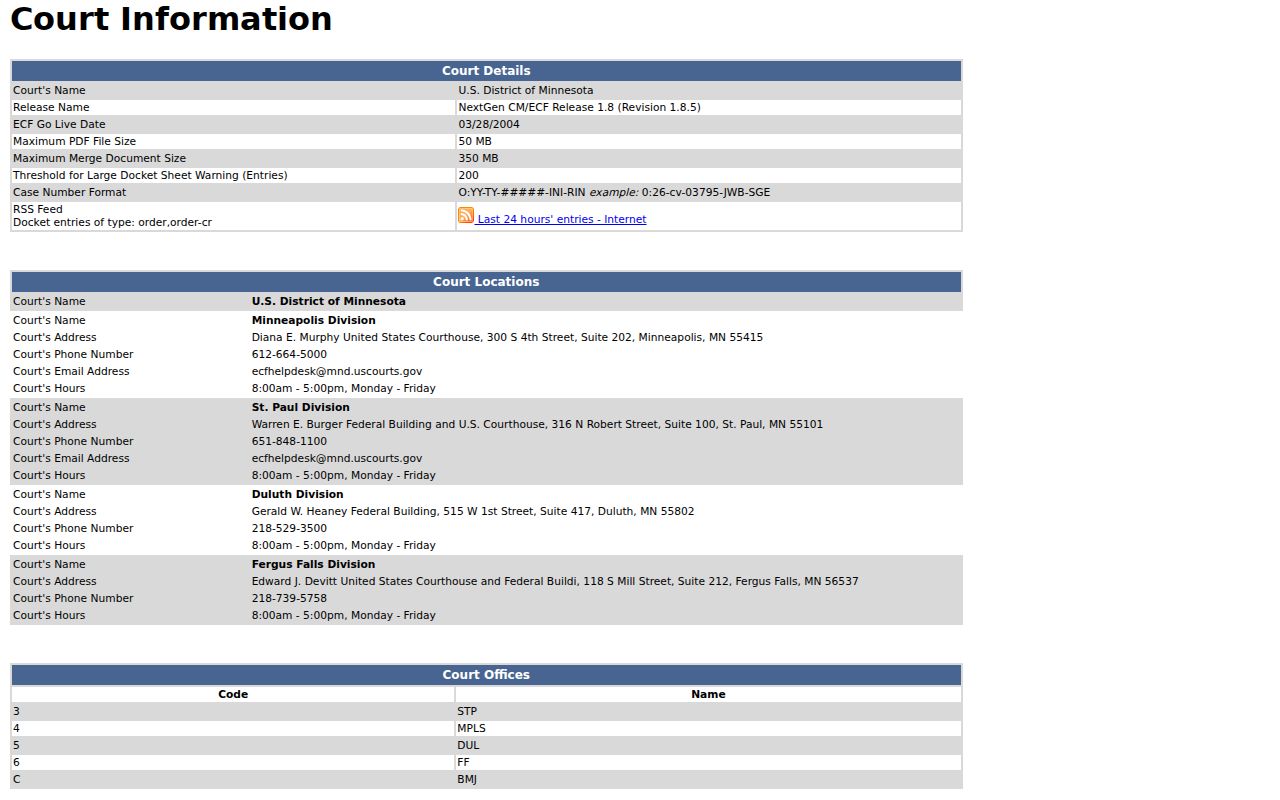
The federal court page is helpful as a system distinction. It does not depict a Cook County District Court criminal Register of Actions. Nor does it replace MCRO. The District of Minnesota bankruptcy court’s Duluth courthouse page describes a different federal court location. Bankruptcy is its own federal docket category, separate from any Cook County criminal docket.
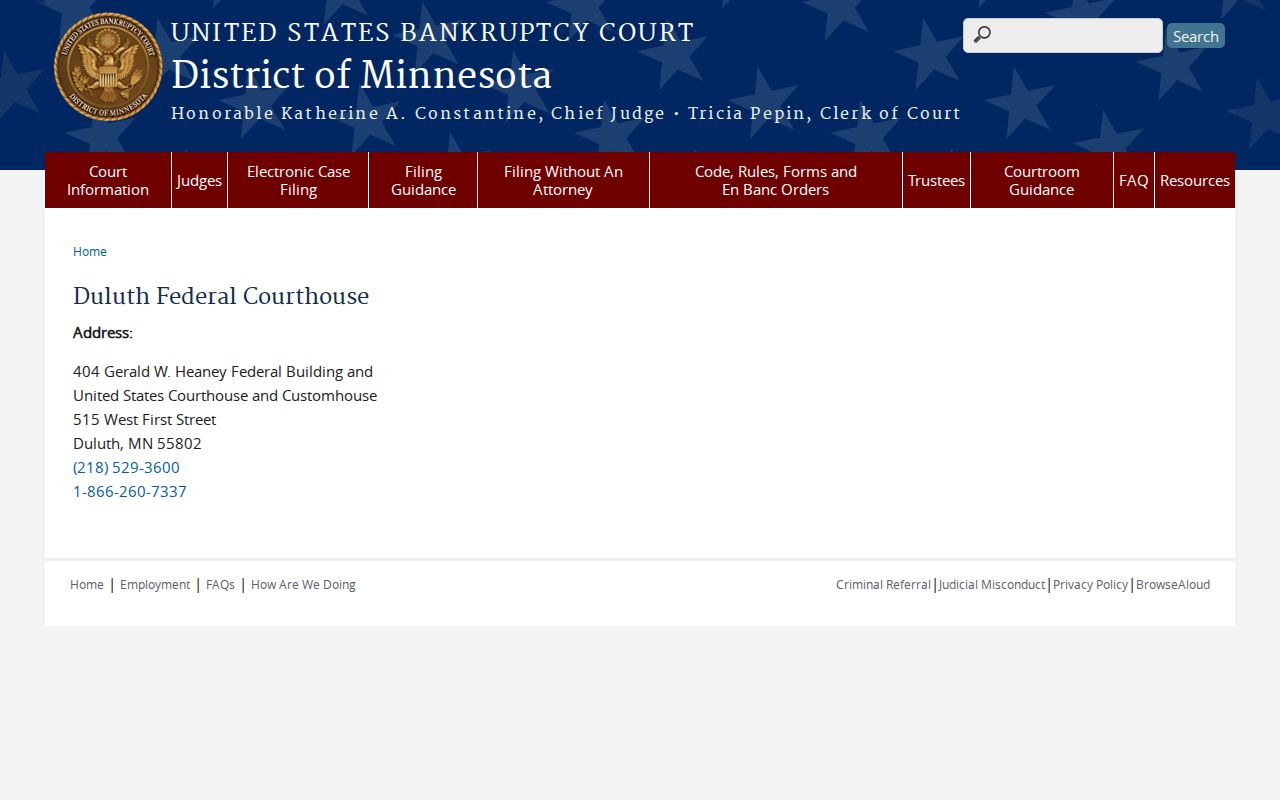
That courthouse reference drives home the boundary. State criminal records stay with Cook County Court Administration. Federal court records sit in a separate system entirely.