
Getting Cook County Court Records
Court Administration in Cook County holds the records of the Minnesota District Court for every trial-court category: civil, family, probate, juvenile, criminal, traffic, and conciliation. Begin with Minnesota Court Records Online, known as MCRO, to locate a Cook County case and its Register of Actions. Anything public that shows up there downloads free. Keep one limit in mind, though. MCRO is unofficial, and no certified record can come from it.
When a remote result falls short, other routes exist. The public terminal at the Cook County courthouse offers fuller electronic access than MCRO does. Court Administration can pull locally stored paper records or walk you through the current copy process. The live Cook court listing posts no general records email, no mail address for the district copy center, and no fax procedure. Call before you send payment or anything sensitive.
- Search MCRO by name, case number, citation number, or attorney, then open Case Details to confirm the Cook County file.
- Use Document Search with the complete case number for a Cook County public electronic document.
- Visit the Cook County courthouse terminal or counter if a public result is not remotely available or the file may be older.
- Call Cook County Court Administration to ask for the current copy-request route, certification level, delivery method, and county-selected fee.
- Use the Cook County Rule 7 access process instead of an ordinary copy request when the material is confidential or sealed.
Note: Give Court Administration the strongest starting point you can for a Cook County record request. That means a case number, the caption, the document name, and roughly when it was filed or heard.
Cook MCRO Document Search
MCRO splits its tools in two. A Cook County case lookup is one thing; a Cook County document lookup is another. The Document Search screen wants the complete case number and offers Find Documents and Clear buttons. Type the number with or without dashes or leading zeroes, but spaces trigger an error. One caution belongs here. A linked document list never promises that every item in a Cook County file is available remotely.
Coverage depends on the date and type of file. For major and minor Cook County criminal and civil files filed on or after July 1, 2015, MCRO lists public documents in the categories the Judicial Branch describes. Listed probate, guardianship, conservatorship, and trust documents appear too. Family access runs narrower. Court-prepared orders, appellate opinions, and notices may appear, while party-filed family materials generally do not. Older Cook County electronic coverage stays limited. The MCRO Document Search interface is the official public starting point when the Cook County file number is known.
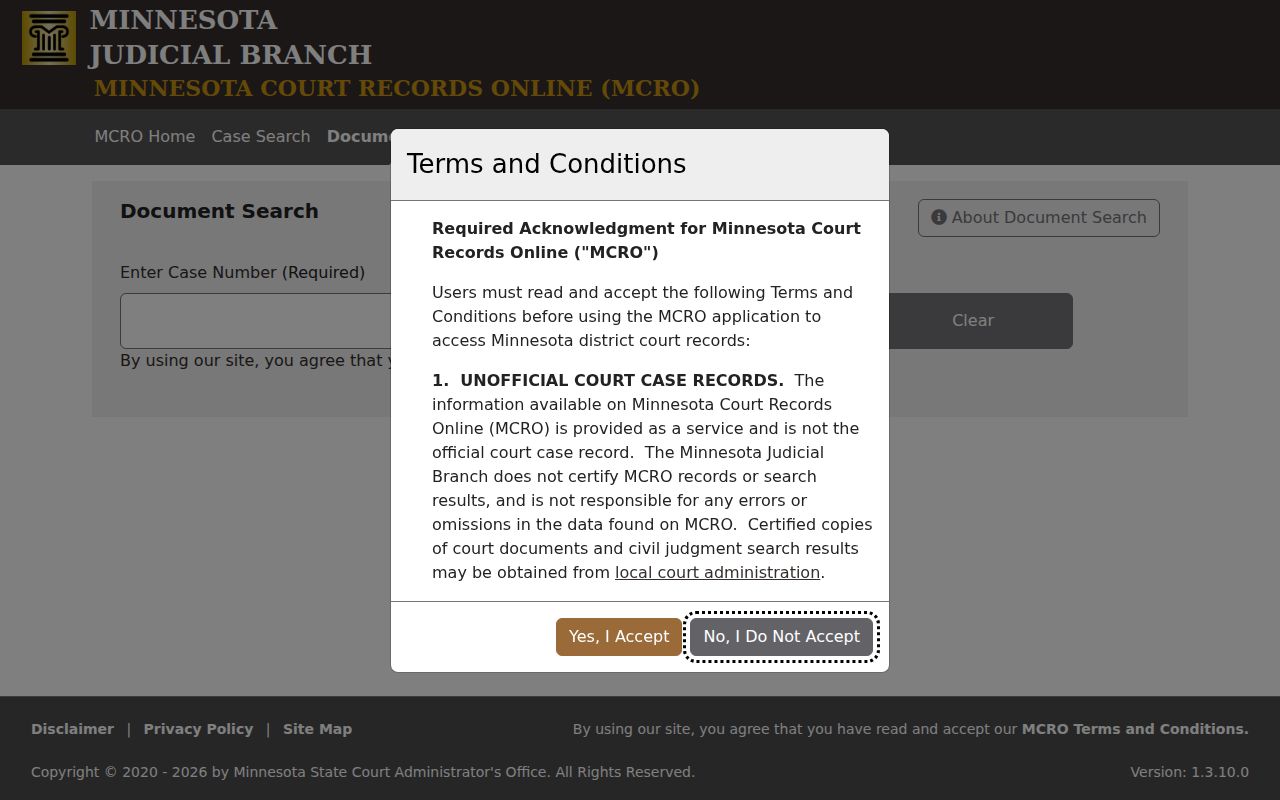
Confirming the number in Case Details first saves time.
Court Record Types
A Cook County court record search can land on three different things. The Register of Actions is the chronological public index of filings, hearings, orders, and dispositions. A filed document sits underneath that index. It is the complaint, motion, affidavit, order, judgment, notice, exhibit, or transcript itself. Public access must permit it. The certified copy is separate again. It carries court certification, not just an MCRO download labeled certified.
- Cook County case information, parties, case events, hearings, and financial entries in the Register of Actions
- Cook County public complaints, petitions, answers, motions, orders, judgments, and notices
- Cook County money-judgment information in the statewide Judgment Search
- Cook County plain, certified, exemplified, or certified-and-exemplified copies from Court Administration
- Cook County transcripts prepared by the court reporter through a separate request path
Cook County Court Administration is the local custodian for every trial-court category. There are no separate civil, probate, criminal, or municipal clerks. Say which kind of copy you want, because the fee, route, and format all differ.
Cook Docket, Document, Certified Copy
Each of the three Cook County records answers a different question. The Register of Actions shows the case history. A filed document gives you the text behind an event, when it is public. A certified copy proves Court Administration authenticated it. A Cook County docket entry can still be visible. Its attachment may be restricted, courthouse-only, or missing from remote access.
| Record | Best use | Cook County access route |
|---|---|---|
| Cook County Register of Actions | Find Cook County events, settings, parties, and disposition history | MCRO Case Search or the Cook County courthouse terminal |
| Cook County public filed document | Read a public Cook County motion, order, judgment, or notice | MCRO Document Search, then the Cook County terminal or Court Administration if needed |
| Certified copy | Obtain a court-certified instrument or printout | Cook County Court Administration or the Sixth District copy process |
MCRO states plainly that its information is unofficial. A certified record, including a certified judgment search, must come from the court itself.
Inside a Cook County Court Record
The Cook County Register of Actions appears in MCRO Case Details. Its blocks may include a case overview, case information, party roles, assignments, case events, hearings, dispositions, bond or bail activity, financial information, related cases, and public documents. The list varies by case. Some blocks are conditional. Charges and warrants, for instance, appear only when that case type has data to show.
| Cook County case number | The Minnesota court-file identifier, commonly built from county, case type, year, and sequence components. |
|---|---|
| Cook County case events | Dated Cook County filings, notices, orders, payments, hearings, and other activity in the Register of Actions. |
| Cook County parties | Roles such as plaintiff, defendant, petitioner, respondent, State, business, and attorney relationships. |
| Cook County hearings | The date, time, location, type, status, and judicial officer where displayed. |
| Cook County dispositions | The recorded outcome and date. A case category does not establish the final result. |
| Cook County documents | Public electronic filings where the case type, date, and access rule allow remote display. |
A Minnesota case number can look like 27-CR-24-1844. Always check the county number against the actual Cook notice or live record. Personal identifiers, exhibits, and protected material stay outside ordinary remote access.
Note: An Index# or DOC ID# identifies a document in the system. It does not necessarily place it in chronological order.
Cook Courthouse Terminal Access
Need more than MCRO shows? The Minnesota Public Access Courthouse terminal at the Cook County Courthouse is the deeper electronic channel. It covers Cook County District Court records in fuller detail. Use it when MCRO lists a Cook County docket but hides the document. Use it when a name search stalls. Use it too when an older Cook County matter seems only partly online. The same public-access rules still apply. A sealed or confidential Cook County file stays sealed at the terminal.
Court Administration sits inside the Cook County Courthouse. The address is 411 W. 2nd St., Grand Marais, MN 55604. Hours run Monday through Friday, 8:00 a.m. to 4:30 p.m. Call (218) 264-7001, option #2. Bring a case number, caption, citation number, or a useful date. That speeds up any inspection of a stored paper court file.
Cook County Court Administration
Cook County Courthouse
411 W. 2nd St., Grand Marais, MN 55604
(218) 264-7001, option #2
Viewing an original file at the counter does not mean you can take it home. Removal is not allowed. Court Administration can explain the current route for copying or certifying paper materials.
Fees and Certified Copies
Plain Cook County copies are free, per the Judicial Branch. A certified copy bears the court seal and generally runs $14 per document. Exemplified copies also generally cost $14. They carry verification from a judicial officer and the court administrator. Put both protections together and the exemplified-and-certified instrument generally costs $28. Treat these as base catalog amounts. The Cook County fee selector may add a law-library charge. Confirm the total before requesting a paid copy.
| Cook County record item | Published base amount |
|---|---|
| Plain copy or uncertified MNCIS printout | $0 |
| Certified civil or criminal instrument, certified printout, or certified screen print | $14 |
| Exemplified, uncertified instrument | $14 |
| Exemplified and certified instrument | $28 |
| Scanning a dismantled file, per 50 pages or part | $25 |
The District Court fee catalog holds the statewide schedule behind these amounts. A judge can waive a certified-copy fee in a given case. Report charges also appear there: $5 for 1 to 50 pages, and $25 per 50 pages or part beyond that.
Cook Transcripts Follow a Different Route
A transcript is different. It is the word-for-word record a court reporter prepares, not the clerk's docket copy. If a Cook County transcript was filed and is public, MCRO or the standard copy process may reach it. If it never was filed, send a written request to the reporter through Court Administration with the Cook County case number and hearing date.
Rates come from the Sixth Judicial District. Criminal and juvenile-delinquency work runs $4.25 per page. Civil, family, probate, child-protection, and SPP/SDP transcripts cost $5.75 per page, while qualifying IFP requests pay $4.25. Reporters deliver electronically, not on paper. Timing varies and expedited rates are negotiable. Confidential-hearing requests need a form and a judicial decision. Sixth Judicial District transcript requests spell out the reporter route for Cook County hearing records.
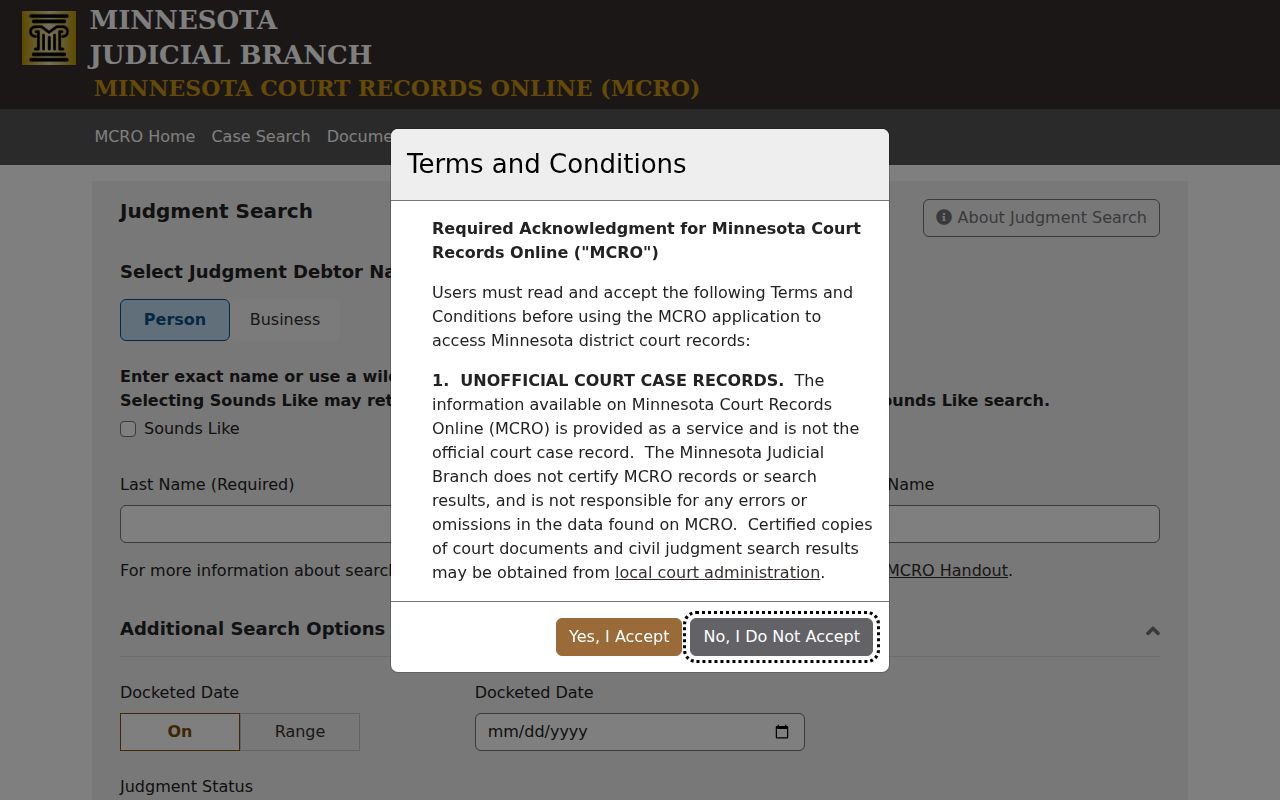
Judgment Search can point you to a monetary judgment. The full Cook County record still lives in Case Details or with Court Administration.
Sealed Records and Public Access
The Minnesota Rules of Public Access draw a line between two channels. One is inspection with the Cook County record custodian. The other is narrower Cook County remote access. At the courthouse, an ordinary public Cook case is open. MCRO is free and needs no account. But it omits or limits plenty: Cook County domestic-abuse and harassment files, CHIPS and D-16 juvenile matters, civil-commitment documents, trial and hearing exhibits, protected identifiers, and some pending criminal or traffic results searched by defendant name.
Cook County access rules:
Rule 8 of the Minnesota Rules of Public Access explains inspection, copying, remote access, and protected fields.
Rule 4 identifies case-record categories that are not routinely public.
Rule 7 provides the procedure for seeking access to a record outside ordinary public access.
Minn. Stat. § 13.03 states Minnesota's inspection and copying baseline for public government data, subject to judicial-record rules.
Sealed or expunged material may vanish from a remote search or show up as restricted. Someone with a legal basis to see confidential records can use the Rule 7 and CON100 process. Court Administration will point to the required route. A disputed access question is decided by a judge.
Cook Missing-Document Steps
A missing link proves nothing. It does not show a Cook County document was never filed. Start with the complete Cook County case number. Gather the document date, the case category, and MCRO's Cook County remote-access coverage. Cook County documents from before July 1, 2015 may have limited online availability. Some public information exists only at the courthouse terminal. A case page with no public document can also reflect protections tied to its case type.
Then use the public terminal or call Court Administration. Name the exact document, event, and case number. If you need a copy, ask for the current copy-request form. Confirm current mailing, email, delivery, and payment instructions directly, since a former Sixth District copy-request PDF may be outdated. Federal court documents take a different route entirely. District of Minnesota PACER information points federal record users to PACER and the federal clerk. It does not point to MCRO or Cook Court Administration.
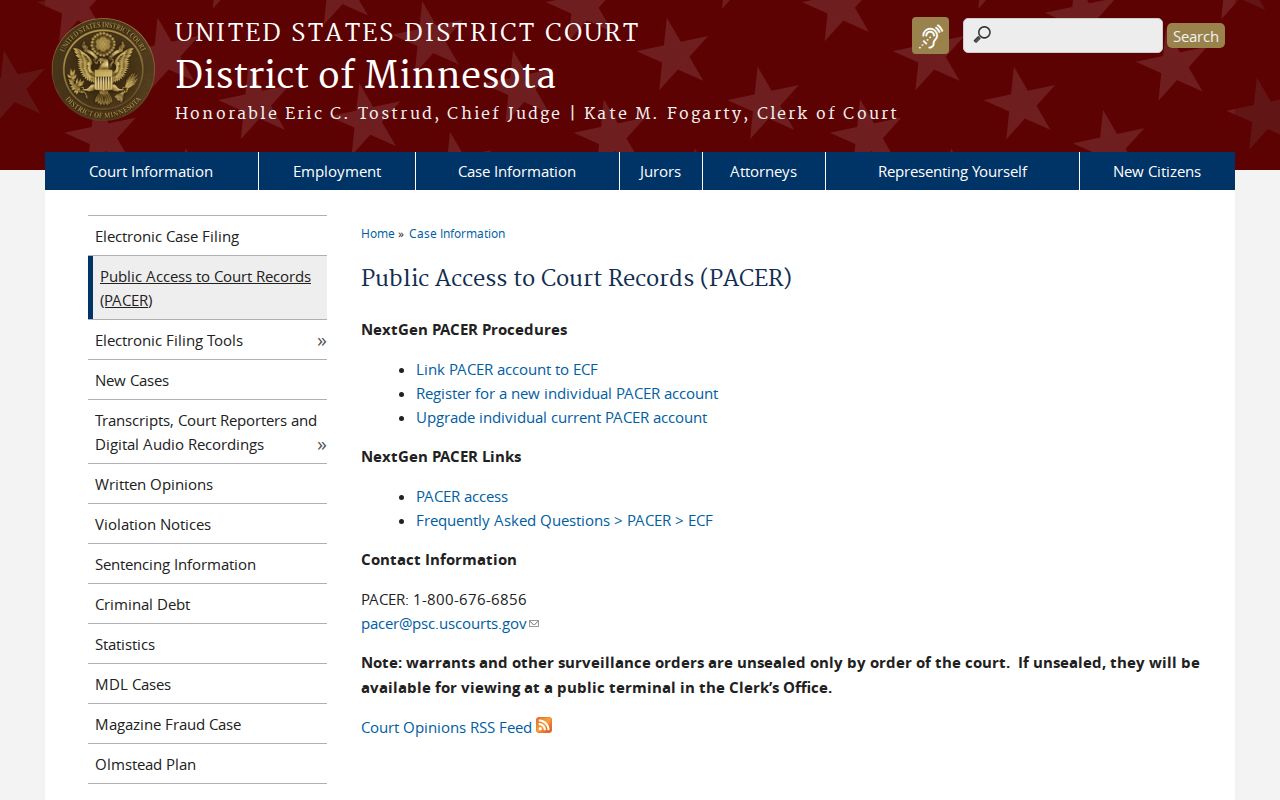
Federal PACER access is not part of the state Register of Actions. That holds even though the nearest federal courthouse is in Duluth. The District of Minnesota contact page lists the Duluth federal courthouse, one more reason to keep federal and Cook County record requests apart.
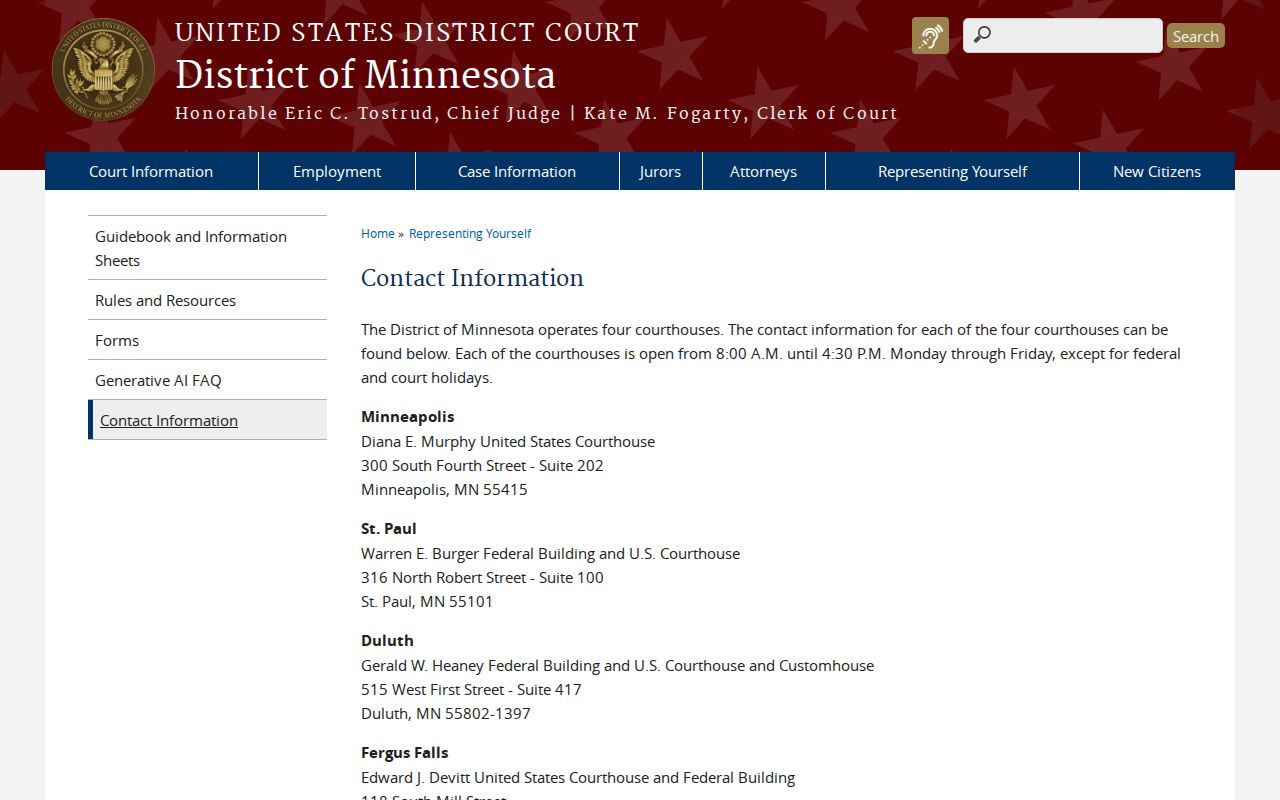
For a state Cook County file, the local custodian is Cook County Court Administration in Grand Marais. Note: Request the current copy route before mailing anything, so you are not relying on a retired Sixth District form or an unconfirmed delivery address.