
Searching Cook County Civil Dockets
For a remote search, begin at Minnesota Court Records Online (MCRO) Case Search. Pick the Civil category. Set the county to Cook when you want only local results. MCRO lets you search by a person or business name, file number, attorney or bar number, filing-date range, or case status. Each match opens a Case Details view with the Cook County Register of Actions inside.
Nothing beats a full file number for pinning down a Cook County civil case. With a name search, confirm you have the right matter by checking the caption, court location, filed date, and category. Family and probate sit under separate MCRO headings. The same courthouse handles them. Document Search only works with a complete case number. When a search has to cross categories, the Cook County case lookup offers shared name, number, citation, and attorney fields.
- Accept MCRO’s terms and open Case Search with the Civil category selected.
- Select Cook County under specific county court locations and enter a party, business, file number, or attorney detail.
- Open the result that matches the Cook County caption, Cook County venue, and filing date.
- Read Cook County Case Events, Hearings, Dispositions, and public documents as separate parts of the Register of Actions.
- Use the Cook County courthouse terminal or Cook County Court Administration if a public document is missing or a certified copy is required.
Cook County Civil Docket Unified Court
One Minnesota District Court location handles all of it in Cook County: civil, family, probate, juvenile, criminal, traffic, and conciliation alike. Per Cook County District Court, local records live with Cook County Court Administration. No county, justice, or municipal civil clerk holds them. The courthouse sits at 411 W. Second Street in Grand Marais. Because of that single venue, the case category and court location listed on the docket should steer a Cook County civil docket search. Any guess about a lower court label should not.
Cook County belongs to the Sixth Judicial District. The county posts no court-at-law, justice-of-the-peace civil docket, or Grand Marais municipal civil portal; none exists among its official offerings.
One caution: sharing a courthouse has limits. Not every category follows the same remote-document rules or public display limits.
Inside a Cook County Civil Docket
A Cook County civil Register of Actions puts basic case data next to a running event history. The official MCRO Case Details guide lists the fields you may see. Those include case information, party information, related cases, assignment, events, hearings, dispositions, financial information, and public documents. A missing block usually means that category holds no data. Even so, an available Cook County event can still hide a document. That document may be courthouse-only or restricted.
| Case number | A Minnesota file identifier with county or district, case-type letters, filing year, and sequence, such as XX-CV-YY-NNNN. |
|---|---|
| Caption and parties | Party names and roles, such as plaintiff, defendant, petitioner, respondent, intervenor, and attorney of record. |
| Case information | Filed date, Cook County venue, judicial officer, status, flags, and related-case information where entered. |
| Case events | Dated Cook County entries for pleadings, service, motions, notices, orders, settlement activity, trial, and judgment. |
| Hearings | Scheduled Cook County date, time, location, judicial officer, setting type, and hearing status where public. |
| Disposition | The recorded Cook County case result, such as a dismissal, default judgment, agreed judgment, or judgment after trial. |
| Documents | Available Cook County public document links, with access dependent on the category, filing date, and privacy rule. |
Index# and DOC ID# identify documents in the court system. They show what was filed, not that any event was granted or denied.
Cook County Civil Docket Conciliation Court
Small claims in this county run through Conciliation Court. That is the small-claims track inside the Cook County District Court structure. Per the Minnesota Judicial Branch, general claims of $20,000 or less qualify for filing there. So where should you search? Conciliation is just a category in the Cook County courts. It is not a separate city or justice-court website with its own portal. The Cook County Register of Actions and Cook County Court Administration stay the local routes. Use them for tracking down the case and asking about public records.
| Cook County case track | Where it is held | How it appears in a search |
|---|---|---|
| Major civil | Cook County District Court | Civil category and Cook County location in MCRO. |
| Conciliation or small claims | Cook County District Court Conciliation Court division | Cook County court record with the appropriate case category or file number. |
| Family | Cook County District Court | Cook County Family category, with distinct remote-document access rules. |
| Probate or mental health | Cook County District Court | Cook County Probate or Mental Health category, subject to privacy limits. |
Before assuming which public document exists, read the system category and the case information on the docket entry first.
Civil Case Types on the Docket
A Cook County civil docket covers a wide range of civil proceedings. Family and probate matters sit apart. They are filed under their own MCRO categories at the same Cook County District Court location. Follow a typical civil case and the docket tells a story. The start, service, responses, motions, notices, orders, settlement activity, trial, and judgment all leave entries behind. A broad label only gets you so far. The specific Cook County case type, the caption, and the disposition tell you far more. Each category can pull in different Cook County records. Each carries its own limits on remote docket access.
- Contract, property, tort, and other general civil claims.
- Conciliation Court claims within the statewide small-claims limit.
- Family matters, which have specialized remote-document rules.
- Probate, guardianship, conservatorship, and trust matters.
- Post-judgment events, including satisfaction or public writ activity where entered.
Cook County Civil Docket Motion Orders
On a Cook County civil docket, a motion entry is a request, not a ruling. The Register may list a motion filed, a notice of hearing, a response, and a hearing held before any order appears. Each step is just paperwork or an event. Until you read the signed Cook County order and its stated disposition, treat the motion as undecided. Default judgments deserve the same care. A default entry means judgment was entered after a party failed to respond or appear. The judgment itself carries the details that matter.
- Motion
- A request for court action that may lead to a response, hearing, and signed order.
- Default judgment
- A recorded judgment entered after a party did not timely respond or appear, subject to court procedure.
- Nonsuit or dismissal
- An ending of a claim or case that should be read for its exact recorded terms.
- Agreed judgment
- A judgment reflected by the court record that requires its own wording and filed document for detail.
Civil Docket Settings and Hearings
A Cook County civil docket can list the hearing date, time, location, judicial officer, setting type, and status for any publicly accessible matter. That is a lot of useful detail. The Cook County weekly public calendar goes up at 7:00 a.m. each business day and gets hourly updates, so it works well as a day-to-day Cook County session view. It does not cover every case, though. For the most current daily information, the court points to printed calendars posted outside Cook County courtrooms and in Cook County public lobbies.
| Date and time | The scheduled setting shown in the latest hearing entry, subject to later continuation or reset. |
|---|---|
| Location | The courthouse or courtroom detail displayed for the public hearing. |
| Judicial officer | The judge, referee, or other officer assigned when the Register displays an assignment. |
| Setting type | A listed event such as motion hearing, status conference, trial, review, or another court setting. |
| Hearing status | A later notation, including held, canceled, continued, or reset, read with the newest event. |
Two terms pop up in Cook County civil settings. A continuance pushes an existing hearing date later. A reset creates a new setting after the old one changes. When a Cook County date truly matters, verify it by phone. Call Cook County Court Administration at (218) 264-7001, option 2. Have the Cook County file number and case caption ready. Staff there can confirm the current Cook County date, time, and location. Do this whenever public sources disagree with each other.
Cook County Civil Docket Judgment Search
Money judgments get their own tool in Cook County. Search public docketed money judgments through MCRO Judgment Search. It filters by debtor name, docketed date, status, and Cook County court location. Keep its limits in mind. It is not a general outcome search. Non-monetary Cook County results such as dismissals and other case dispositions stay in the case's Case Details and Dispositions section rather than the money-judgment results. Post-judgment docket entries in Cook County can show a recorded satisfaction. They may also show a transcript or abstract-type filing, or public garnishment and writ activity where entered. Read those Cook County entries alongside the underlying judgment and in order. A judgment-search result alone does not replace the full Cook County Register of Actions, the judgment document itself, or a current certified copy from Cook County Court Administration.
Cook County civil docket distinction: Judgment Search finds docketed money judgments; Case Details explains the full event history and other outcomes.
Civil Docket Access Rules
Two authorities control access to Cook County civil court records. One is the Minnesota Rules of Public Access. The other is the Minnesota Government Data Practices Act. In person, the public may inspect accessible Cook County originals held at the courthouse. Remote electronic access runs narrower. MCRO leaves out protected identifiers and applies Cook County case-type limits, so some material never appears online. Orders, opinions, and notices generated in family cases may be available remotely. Party-submitted family documents generally are not. Cook County probate, guardianship, trust, juvenile, and civil-commitment records can carry their own privacy restrictions on top of that.
Cook County civil record rules:
Rule 8 addresses public inspection, copying, remote access, protected identifiers, and trial or hearing exhibits.
Rule 4 identifies categories with limits on routine public access.
Rule 7 provides a procedure for requesting access to a record that is not routinely available.
Minn. Stat. § 13.03 provides the public-data inspection and copying baseline, subject to judicial-record rules.
Sealed or confidential Cook County records follow a different route. The Rule 7 and CON100 access path may apply. A judge may have to rule on a disputed request before anything is released. A Cook County courthouse terminal can offer fuller public electronic access than remote options. Even so, the terminal does not override a restriction. It does not create a right to confidential material.
Cook County Civil Docket Document Paths
Sometimes a Cook County civil docket is visible but the document behind an entry is not. Start with the Cook County category and filing-date limits that apply to remote MCRO documents. For public Cook County records restricted to courthouse-only access, use the Cook County courthouse terminal or ask Cook County Court Administration at 411 W. Second Street, Grand Marais, Minnesota 55604. Plain Cook County copies cost nothing under the Judicial Branch catalog. A certified Cook County copy generally runs $14 per document, an exemplified copy generally $14, and an exemplified-and-certified copy generally $28, subject to the current county fee selector. Call ahead for Cook County mail or email copies to get the current form, delivery method, and payment instructions. The Minnesota access-records page lays out the remote, terminal, and court-counter channels.
Above the trial level sits the Minnesota Supreme Court, the highest state court, which takes direct review of specified matters. Its appellate docket is separate from any Cook County civil trial docket.
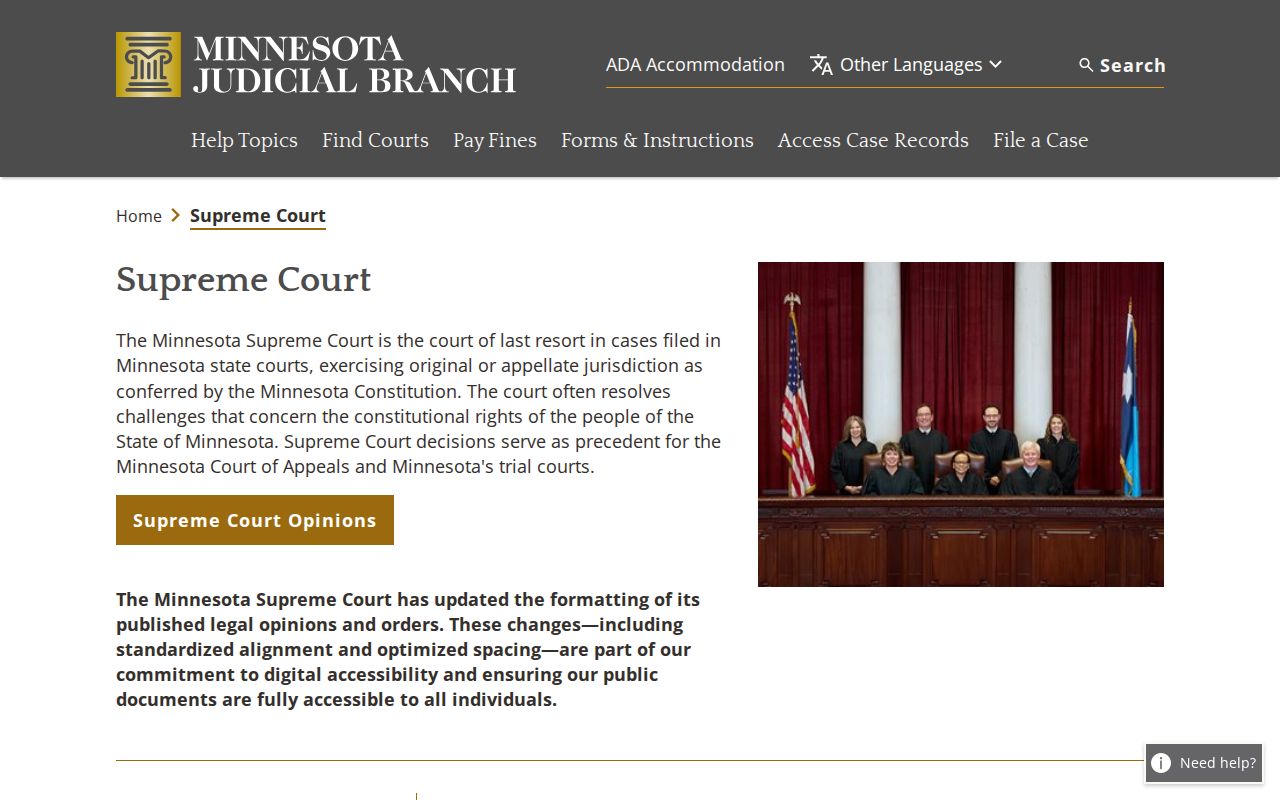
A civil appeal in Minnesota climbs a distinct ladder. The state high court sits at the top of it. Its record is not the Cook County District Court Register of Actions for the underlying case. The Minnesota Court of Appeals handles most appeals from District Court final decisions. It serves as the intermediate error-correcting court. Those two appellate layers stay separate from Cook County civil records.
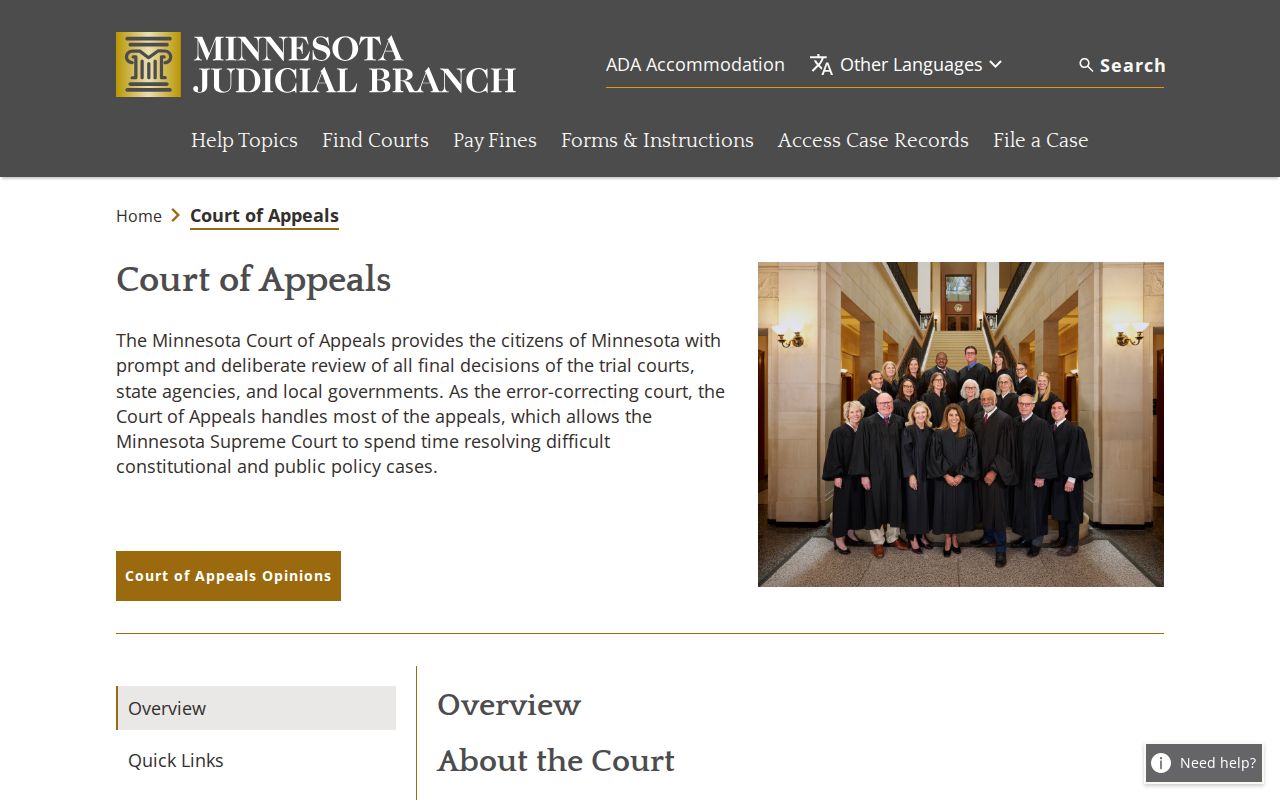
An appeal can leave a mark on the trial side. It may appear as an event or filing in the Cook County civil Register. The appeal then moves forward under its own appellate record. The trial docket stays closed. Federal review runs on a separate track entirely. The United States Court of Appeals for the Eighth Circuit covers Minnesota. It is the federal appellate court. It shares no docket with the Minnesota Court of Appeals. The same goes for Cook County civil court records.
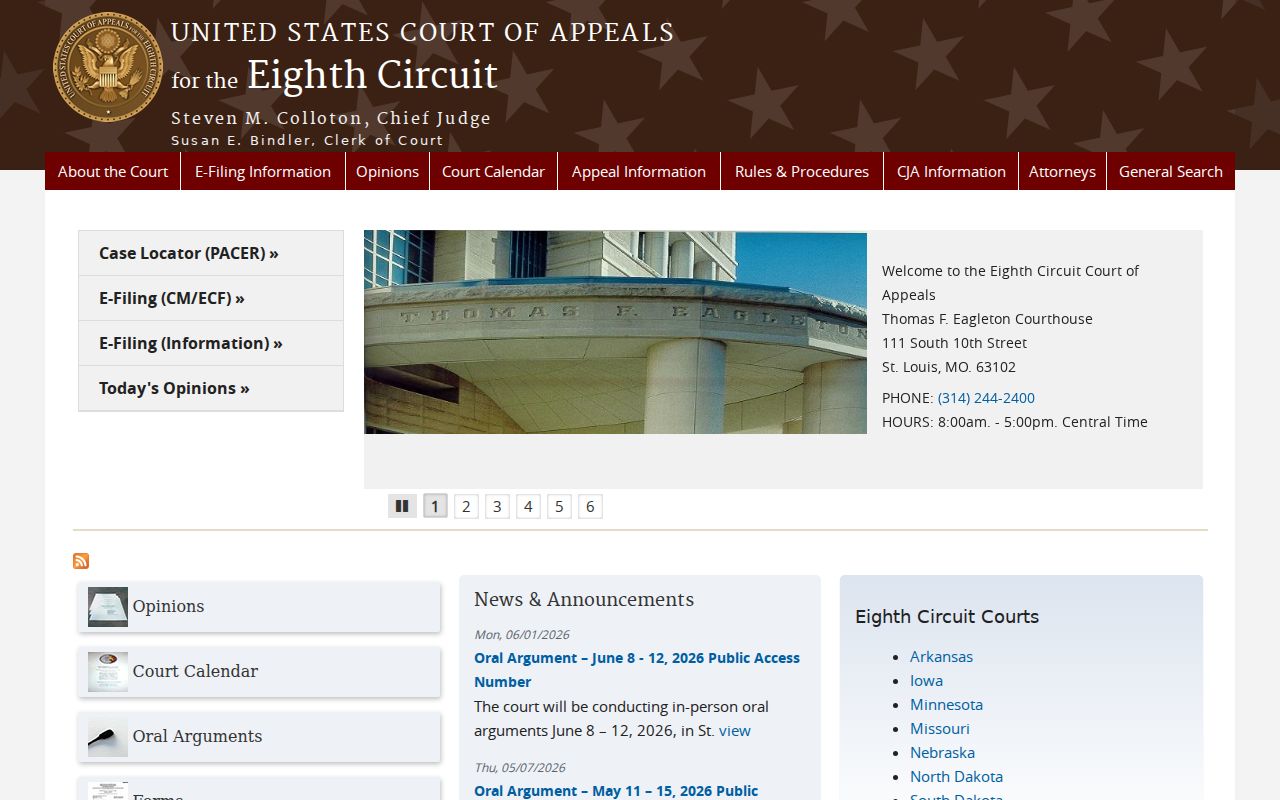
That federal layer marks where state court authority ends. Cook County Court Administration maintains the county's Minnesota District Court civil records, not state or federal appellate files.
Note: MCRO cannot issue certified documents, so a certificate, seal, or older file request belongs with Court Administration rather than a downloaded record.